
All-on-4 dental implants replace a full arch of missing or failing teeth with a fixed bridge anchored by just four titanium implants, giving patients a permanent set of teeth without the bulk or slippage of traditional dentures. For North American patients facing quotes of $20,000 to $40,000 per arch at home, Mexico has become a primary destination for this procedure, with clinics in Tijuana, Los Algodones, and Cancun treating patients from the United States and Canada every week. A well-planned All-on-4 trip to Mexico can cost 50 to 70 percent less than the same treatment at home, provided the estimate accounts for implant brand, bridge material, and every stage of care from extraction through the final prosthesis.
Global Med Authority coordinates dental tourism and broader medical tourism trips for patients considering full-mouth restoration abroad, and Mexico consistently ranks among the destinations we recommend for dentistry because of its proximity to the US border and the volume of experienced implant providers. The savings are real, but so are the variables that separate a straightforward outcome from a frustrating one. This guide walks through what All-on-4 actually involves, what a legitimate cost breakdown looks like, and how to vet a clinic before committing to treatment.
How Does All-on-4 Restore a Full Arch of Teeth?
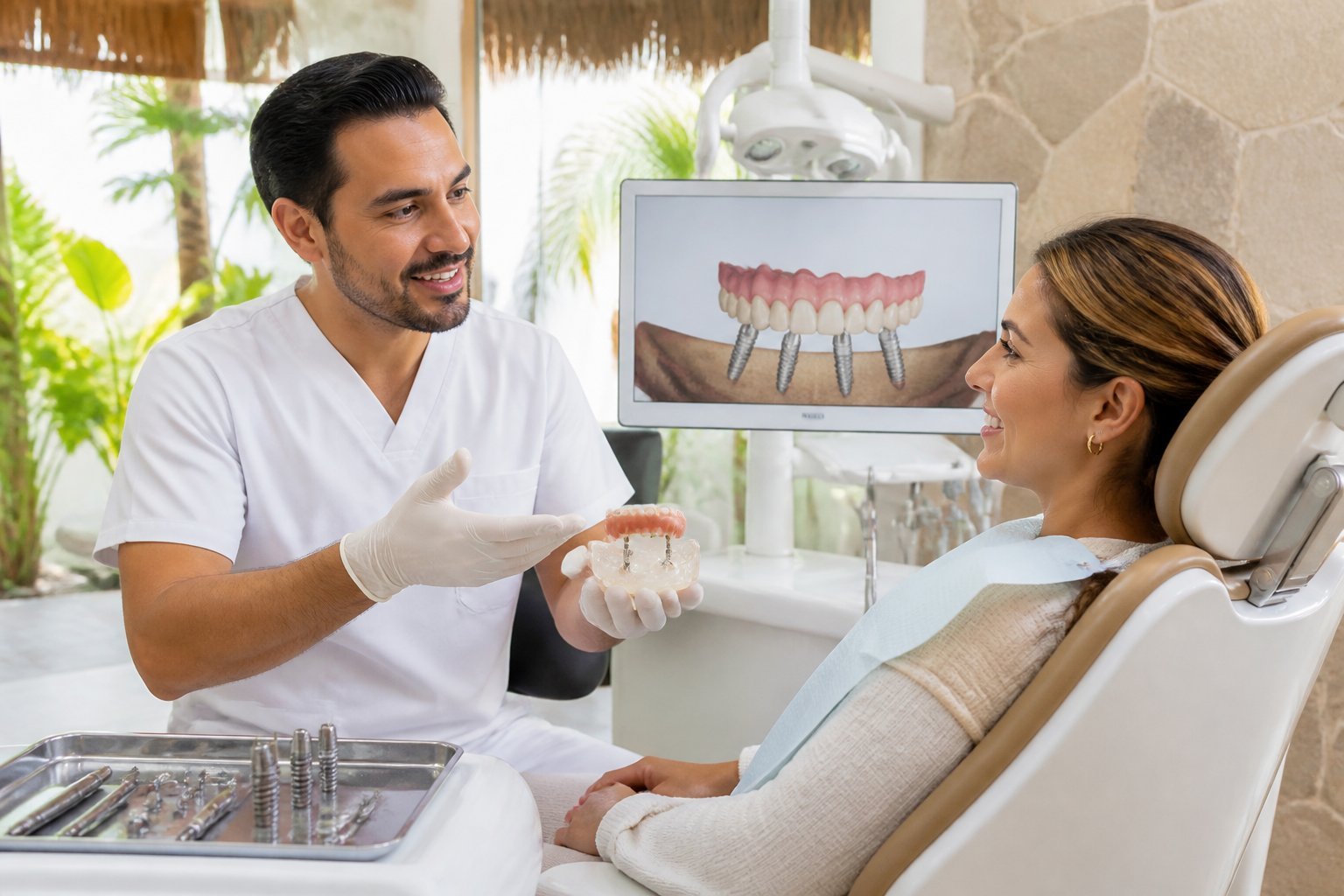
All-on-4 replaces an entire arch of missing or failing teeth using four strategically placed titanium implants that support one fixed bridge. Two implants go in vertically at the front of the jaw, and two are angled toward the back to make use of available bone, which is why many edentulous patients qualify without needing a bone graft first.
How Four Dental Implants Support a Fixed Bridge
The four implants act as anchor points for a hybrid denture or permanent bridge that carries 10 to 14 teeth. Once placed, the implants undergo osseointegration, the process by which bone fuses to the titanium surface over three to six months. That fusion is what gives the final prosthesis the strength to function like natural teeth rather than shifting or clicking the way removable dentures can.
All-on-4 vs. Traditional Dentures and Individual Implants
Traditional dentures rest on the gums and often loosen over time, requiring adhesive and diet restrictions. Individual implants replace one tooth per implant, which can mean six or more implants per arch and a higher total cost. All-on-4 sits between the two: fixed like individual implants, but built around a design that uses fewer implants and less bone.
| Option | Fixed or Removable | Implants Needed | Typical Feel |
|---|---|---|---|
| All-on-4 | Fixed | 4 | Natural, permanent |
| Traditional dentures | Removable | 0 | Loosens over time |
| Individual implants | Fixed | 6-8+ per arch | Natural, highest cost |
Who May Be a Candidate for Full-Arch Treatment
Patients with significant tooth loss, advanced gum disease, or a full arch of failing teeth are common candidates for All-on-4. Bone loss that would rule out conventional implants often still allows for All-on-4 because the angled posterior implants avoid the sinus cavity and nerve canal. A CBCT scan during consultation confirms whether a patient’s bone volume supports the technique or whether a bone graft or sinus lift is needed first.
How Much Does All-on-4 Cost in Mexico?
All-on-4 in Mexico typically runs $6,000 to $16,000 per arch, compared with $20,000 to $40,000 per arch in the United States. The wide range reflects real differences in implant brand, bridge material, and what the clinic includes in the base price, which is why a headline number should never be the deciding factor.
Typical Per-Arch and Full-Mouth Planning Ranges
Single-arch treatment generally falls between $6,000 and $12,000 in Mexico, with some clinics quoting as low as $6,162 and premium zirconia cases reaching $15,000 or more per arch. Full-mouth cases, treating both the upper and lower arch, commonly land between $12,000 and $28,000 total. US pricing for the same scope frequently exceeds $50,000, which is the gap that draws most patients south of the border in the first place.
What an Itemized All-on-4 Estimate Should Include
A trustworthy quote itemizes each stage rather than bundling everything into one number. Look for line items covering:
- Consultation and CBCT or 3D CT imaging
- Tooth extractions, if needed
- Surgical placement of the four implants
- The temporary bridge (often called “teeth in a day”)
- The final bridge or prosthesis
- Follow-up visits and any warranty terms
Anything less detailed makes it hard to compare one clinic’s price against another’s, or to know what happens if a complication arises.
How Bridge Materials and Implant Brands Affect the Price
Implant brand and bridge material drive much of the cost variation between clinics. Nobel Biocare and Straumann implants carry a premium over other systems like Neodent, and clinics that quote unusually low prices sometimes substitute lesser-known brands without disclosing the change. Bridge material matters just as much:
| Bridge Type | Relative Cost | Durability |
|---|---|---|
| Acrylic hybrid | Lowest | 5-7 years before replacement |
| Zirconia (Prettau) | Higher | 15-20+ years, more chip-resistant |
A fixed hybrid acrylic bridge often serves as the temporary bridge worn during healing, while a zirconia bridge is a common upgrade for the final, permanent prosthesis.
Potential Add-Ons That Change the Total Cost
Bone grafting, sinus lifts, IV sedation, or general anesthesia can add $500 to several thousand dollars depending on complexity. Travel, lodging, and a companion’s expenses sit outside the dental quote entirely, yet they shape the real total cost of treatment. A patient comparing a $7,000 quote in Los Algodones against a $30,000 quote at home still needs to budget for flights, a hotel during the healing period, and possibly a second trip for the final bridge.
How to Choose a Dental Clinic and Destination in Mexico
The right clinic combines verifiable surgeon credentials, modern imaging and lab standards, and a location that fits the patient’s travel needs. Price alone tells us little about whether a provider can deliver a durable result.
Why Surgeon Credentials and Implant Experience Matter
Every practicing dentist in Mexico should hold a cédula profesional, the government-issued license confirming their credentials are on file with the Ministry of Education. Beyond that baseline, look for an implantologist with specific training in full-arch surgery, ideally with case volume they can document. Membership in the Mexican Dental Association or recognized international bodies such as the ITI (International Team for Implantology) adds another layer of verification, and some surgeons also hold American Dental Association affiliations from training in the US.
Which Imaging, Laboratory, and Prosthetic Standards to Verify
A clinic offering All-on-4 should have in-house or contracted access to 3D CBCT scanning, not just a panoramic X-ray, since accurate implant placement depends on seeing bone density and nerve position in three dimensions. Ask whether the bridge is fabricated using CAD/CAM technology (CEREC or comparable systems) and whether the lab is on-site or outsourced. On-site labs generally shorten turnaround for adjustments during the same trip.
Comparing Tijuana, Los Algodones, Cancun, and Other Dental Hubs
Tijuana and Los Algodones sit directly on the US border and draw heavy walk-across traffic from Southern California and Arizona, with Los Algodones nicknamed “Molar City” for its density of dental clinics. Cancun serves patients who prefer to combine treatment with a longer recovery stay, and clinics such as Sani Dental Group and Cancun Dental Specialists have built reputations specifically around All-on-4 and All-on-6 cases for international patients.
| Destination | Border Access | Best Fit |
|---|---|---|
| Tijuana | Walk or short drive from San Diego | Day-trip or short stay patients |
| Los Algodones | Walk from Yuma, Arizona | Border-crossing patients, high clinic density |
| Cancun | Flight required | Patients combining recovery with a longer stay |
Questions to Ask Before Paying a Deposit
Before committing, ask the clinic to confirm implant brand and bridge material in writing, provide their surgeon’s credentials and case volume, and specify what happens if an implant fails during the warranty period. Ask how many trips the treatment plan requires and whether the itemized estimate includes CBCT imaging, extractions, and the final bridge, not just the surgical placement.
What to Expect From Surgery, Healing, and Travel Planning
Most All-on-4 patients travel to Mexico twice: once for extractions and implant surgery, and again months later for the final bridge. Planning around this two-visit structure, rather than assuming a single trip finishes the job, prevents the most common scheduling frustration we see among patients.
Why Most Patients Need a Surgical Visit and a Final-Bridge Visit
The first visit covers any needed extractions, placement of the four implants, and attachment of a temporary bridge, usually completed in a single day. The second visit, scheduled three to six months later once osseointegration is confirmed, replaces the temporary bridge with the permanent zirconia or high-grade acrylic prosthesis. Some clinics offer a single-trip protocol with extended stays, but that arrangement is less common and worth confirming directly.
Temporary Bridge, Healing, and the Osseointegration Period
The temporary fixed bridge lets patients eat soft foods and speak normally while the implants fuse to the jawbone underneath. Swelling and discomfort typically peak in the first 48 to 72 hours and improve steadily over two weeks. Osseointegration itself takes three to six months, and rushing the final bridge before integration is confirmed by imaging raises the risk of implant failure.
Recovery Stays, Blindingying, and Bringing a Travel Companion
Plan on staying near the clinic for at least a few days after surgery before flying home, since swelling and the adjustment to a temporary bridge are easier to manage close to the surgical team. A travel companion helps with meals, medication schedules, and transportation in the first days after anesthesia. Confirm with the clinic and airline what pressure changes and flight duration mean for a fresh surgical site before booking a return flight too soon.
How Global Med Authority Coordinates an Individualized Care Plan
Global Med Authority builds each patient’s trip around their procedure, timing, and recovery needs rather than fitting them into a fixed package. That includes comparing clinics on accreditation and itemized pricing, coordinating flights and recovery lodging, and planning for post-operative follow-up once the patient is back home. Patients considering dental tourism in Mexico, or comparing it against options like dental implants in Costa Rica, can request a free assessment built around their specific case.
A Better All-on-4 Decision Starts With an Itemized Plan
All-on-4 treatment in Mexico offers substantial savings over US pricing, but the number on a quote only tells part of the story. Implant brand, bridge material, surgeon credentials, and the number of required visits all shape whether a full-mouth restoration delivers lasting value. Dental tourism and medical tourism in Mexico work best for patients who verify credentials, request itemized estimates, and plan travel and recovery with the same care they give the surgery itself.
Frequently Asked Questions
How much do All-on-4 dental implants cost in Mexico?
All-on-4 typically costs $6,000 to $16,000 per arch in Mexico, compared with $20,000 to $40,000 per arch in the United States. The exact price depends on implant brand, bridge material (zirconia versus acrylic), and whether extractions or bone grafting are needed.
Is it safe to get All-on-4 dental implants in Mexico?
All-on-4 can be performed safely in Mexico at clinics with COFEPRIS-licensed facilities, credentialed implantologists, and modern imaging such as 3D CBCT scans. Safety depends on verifying the specific clinic and surgeon rather than assuming all providers meet the same standard.
How many trips to Mexico are needed for All-on-4 treatment?
Most patients make two trips: one for extractions and implant surgery with a temporary bridge, and a second three to six months later for the permanent bridge once osseointegration is confirmed. A few clinics offer extended single-trip protocols, which is worth confirming before booking.
What is included in an All-on-4 package in Mexico?
A complete package should include consultation and imaging, extractions if needed, surgical placement of the four implants, the temporary bridge, and the final prosthesis. Patients should request written confirmation of what’s included before paying a deposit, since advertised starting prices sometimes exclude later stages.
Are zirconia bridges better than acrylic bridges for All-on-4?
Zirconia bridges last 15 to 20 years or more and resist chipping better than acrylic, which typically needs replacement after 5 to 7 years. Acrylic bridges cost less upfront and commonly serve as the temporary bridge worn during healing rather than the final prosthesis.
Is Tijuana or Los Algodones better for All-on-4 dental implants?
Tijuana suits patients near San Diego who want walk-across or short-drive access to a large concentration of clinics. Los Algodones, nicknamed “Molar City,” offers a similarly dense clinic cluster for patients crossing from Yuma, Arizona, and both destinations work well for border-proximate care.